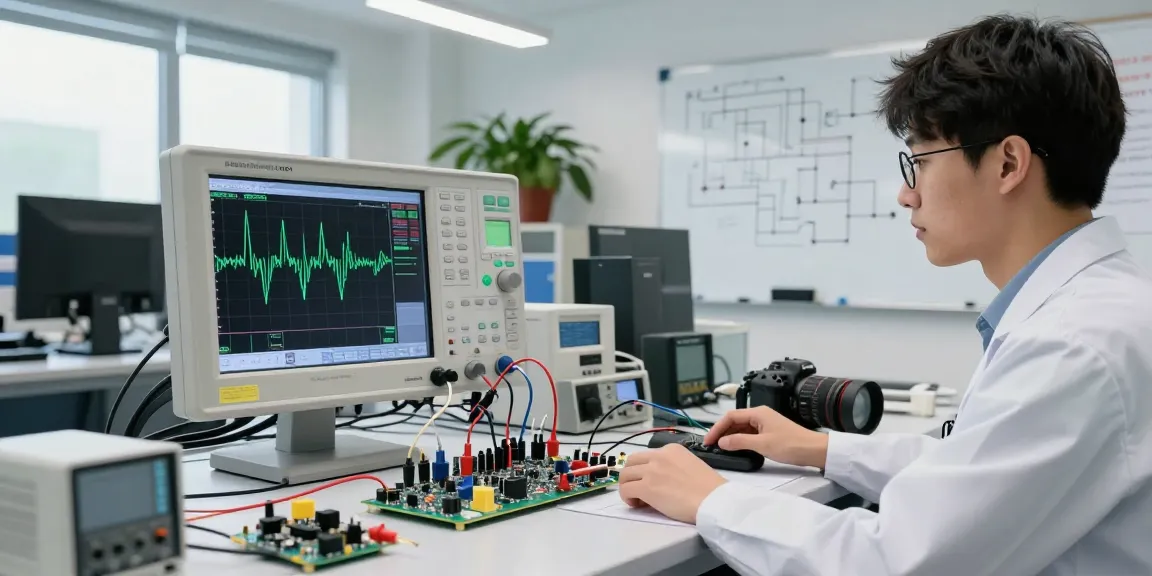
How to Track and Measure Digital Oscilloscope Success in 2026: Expert Techniques for Professionals
Introduction to Digital Oscilloscopes
In today’s fast-paced technological landscape, precision in electronics testing has never been more vital. Digital oscilloscopes are essential tools for engineers, technicians, and hobbyists alike, enabling them to capture, analyse, and display electrical signals with remarkable accuracy. With the introduction of advanced models like the HANMATEK® DOS1202, which boasts a 200 MHz bandwidth and a user-friendly interface, users can expect enhanced performance for both professional and educational applications. When exploring options, Digital Oscilloscope selection is crucial to ensure the right fit for various projects and tasks.
What is a Digital Oscilloscope?
A digital oscilloscope is an electronic instrument that allows users to visualise and measure varying signals, typically voltage, over time. Unlike their analog counterparts, digital oscilloscopes digitise the incoming signal, allowing for advanced analysis, storage, and display capabilities. This transformation makes it easier to track signal behaviour, perform complex calculations, and manipulate data using integrated software. Digital oscilloscopes are essential for a range of applications, from diagnosing issues in electronic circuits to conducting experiments in educational settings.
Key Features and Specifications
When purchasing a digital oscilloscope, it’s important to understand the key features and specifications that can significantly impact performance:
- Bandwidth: A higher bandwidth allows the oscilloscope to accurately measure faster signal transitions. The HANMATEK® DOS1202’s 200 MHz bandwidth is ideal for high-speed digital circuits.
- Sample Rate: Measured in samples per second (S/s), a higher sample rate ensures more accurate signal representation. Ideal models provide a sample rate that is at least 4-5 times the bandwidth to effectively capture waveforms.
- Memory Depth: This refers to the amount of data the oscilloscope can store during a measurement. Greater memory depth is beneficial for capturing detailed signals over longer durations.
- Triggering Options: Advanced triggering capabilities help users isolate specific events in a waveform, increasing measurement accuracy.
- Display Quality: High-resolution displays enhance the ability to view complex waveforms clearly.
Differentiating Digital Oscilloscope Types
Digital oscilloscopes come in various types, catering to different testing scenarios:
- Benchtop Oscilloscopes: Typically used in lab environments, these oscilloscopes are robust and packed with features, ideal for professional-grade applications.
- Portable Oscilloscopes: Designed for fieldwork, these instruments focus on lightweight design without sacrificing essential features.
- Handheld Oscilloscopes: Compact and battery-operated, they offer versatility for quick testing and inspections.
- Mixed Signal Oscilloscopes (MSO): These oscilloscopes combine the functions of digital oscilloscopes and logic analyzers, allowing users to view both analog and digital signals simultaneously.
Understanding the Functionality
How Digital Oscilloscopes Work
Digital oscilloscopes work by sampling an incoming electrical signal and converting it from an analog to a digital format using an analogue-to-digital converter (ADC). The sampled data is then processed by the oscilloscope’s internal CPU, which calculates the signal characteristics and displays them on the screen. This function provides a visual representation of the signal, allowing users to observe its amplitude, frequency, and other essential parameters in real time. The use of digital technology permits greater accuracy, advanced triggering, and storage capabilities compared to traditional oscilloscopes.
Signal Analysis Techniques
Once a signal is captured, several analysis techniques can be employed to extract useful information:
- Fourier Analysis: This technique is used to decompose complex signals into simpler sine and cosine components, aiding in frequency domain analysis.
- Statistical Analysis: Critical for understanding noise, distortion, and other signal integrity issues, statistical tools help in evaluating how signals behave over time.
- Waveform Math: Many oscilloscopes support math functions that allow users to add, subtract, or manipulate waveforms for thorough analysis.
Adjusting Settings for Optimal Performance
To ensure the most accurate results, users must adjust several settings on the oscilloscope:
- Vertical Scale: Adjusting the volts per division helps to amplify signals for easier viewing.
- Time Base: Setting the right time scale is vital for accurately interpreting fast signals; this determines how quickly the oscilloscope samples the signal.
- Trigger Level: Setting the trigger allows the oscilloscope to capture specific events in the signal based on voltage thresholds.
Typical Use Cases
Applications in Professional Engineering
Engineers in diverse fields utilise digital oscilloscopes for various applications, including:
- Circuit Diagnostics: Quickly identifying faults in electronic circuits by observing signal behavior under different conditions.
- Signal Integrity Testing: Verifying the quality of signals to ensure they meet specifications and function correctly in systems.
- Power Analysis: Measuring characteristics of power supplies and ensuring compliance with design standards.
Educational and Laboratory Environments
In educational settings, digital oscilloscopes are instrumental in teaching fundamental electronics and engineering concepts. They allow students to conduct experiments, analyse waveforms, and understand signal behaviours hands-on. Labs utilise them for research and development, where capturing precise data is critical.
Rapid Prototyping and Testing Scenarios
Rapid prototyping requires agility and precision, and digital oscilloscopes provide both. Engineers can quickly test prototypes, verify designs, and iterate based on measurements from the oscilloscope, enhancing the speed and accuracy of product development.
Common Troubleshooting Tactics
Recognising Common Signal Issues
When using digital oscilloscopes, users may encounter common signal issues such as noise, distortion, and incorrect triggering. Recognising these issues is crucial for troubleshooting.
Step-by-Step Troubleshooting Guide
- Check Connections: Ensure all cables and probes are properly connected and functioning.
- Inspect Probes: Verify that probes are compensated correctly and match the oscilloscope settings.
- Adjust Trigger Settings: Modify triggering to eliminate random signals and lock onto the desired waveform.
- Examine Grounding: Inadequate grounding can lead to noise; ensure proper grounding techniques are employed.
- Review Settings: Reset settings to default if the display appears erratic or if issues persist.
Maintaining Digital Oscilloscope Performance
Regular maintenance practices can extend the life of a digital oscilloscope. This includes keeping the device clean, updating firmware as needed, and periodically testing the probes for accuracy. Following best practices encourages long-term reliability and performance.
Future Trends in Digital Oscilloscope Technology
Emerging Technologies to Watch in 2026
The oscilloscopes of 2026 will likely incorporate advances in technology such as AI-driven analysis and enhanced connectivity options. Emerging technologies may enable faster processing speeds and more intelligent data interpretation, allowing users to gain deeper insights without extensive manual analysis.
Impact of AI and Automation
Artificial intelligence is set to revolutionise how we analyse signals. Automating tasks such as signal identification and anomaly detection will not only save time but also reduce the potential for human error, leading to more accurate results.
Predictions for User Experience Enhancements
As digital oscilloscopes evolve, user interfaces will become more intuitive and user-friendly. Expect enhanced touchscreen capabilities and integrated software tools that simplify the learning curve for new users, alongside powerful functionalities for seasoned professionals.
What advantages does using a Digital Oscilloscope offer?
Utilising a digital oscilloscope grants engineers and technicians the advantage of precise measurement and visualisation of electrical signals, facilitating improved design and troubleshooting processes.
Can a Digital Oscilloscope capture high-speed signals?
Yes, high-bandwidth digital oscilloscopes, like the HANMATEK® DOS1202, are specifically designed to capture high-speed signals found in modern electronic devices.
What maintenance does a Digital Oscilloscope require?
Regular cleaning, firmware updates, and probe testing are recommended to maintain optimal performance of a digital oscilloscope.
How do I choose the right Digital Oscilloscope for my needs?
Consider factors such as bandwidth, sample rate, memory depth, and intended applications when selecting a digital oscilloscope that meets your specific requirements.
What signals are typically measured with a Digital Oscilloscope?
Digital oscilloscopes are used to measure a wide range of signals, including digital pulses, analog waveforms, and transients in electronic circuits.